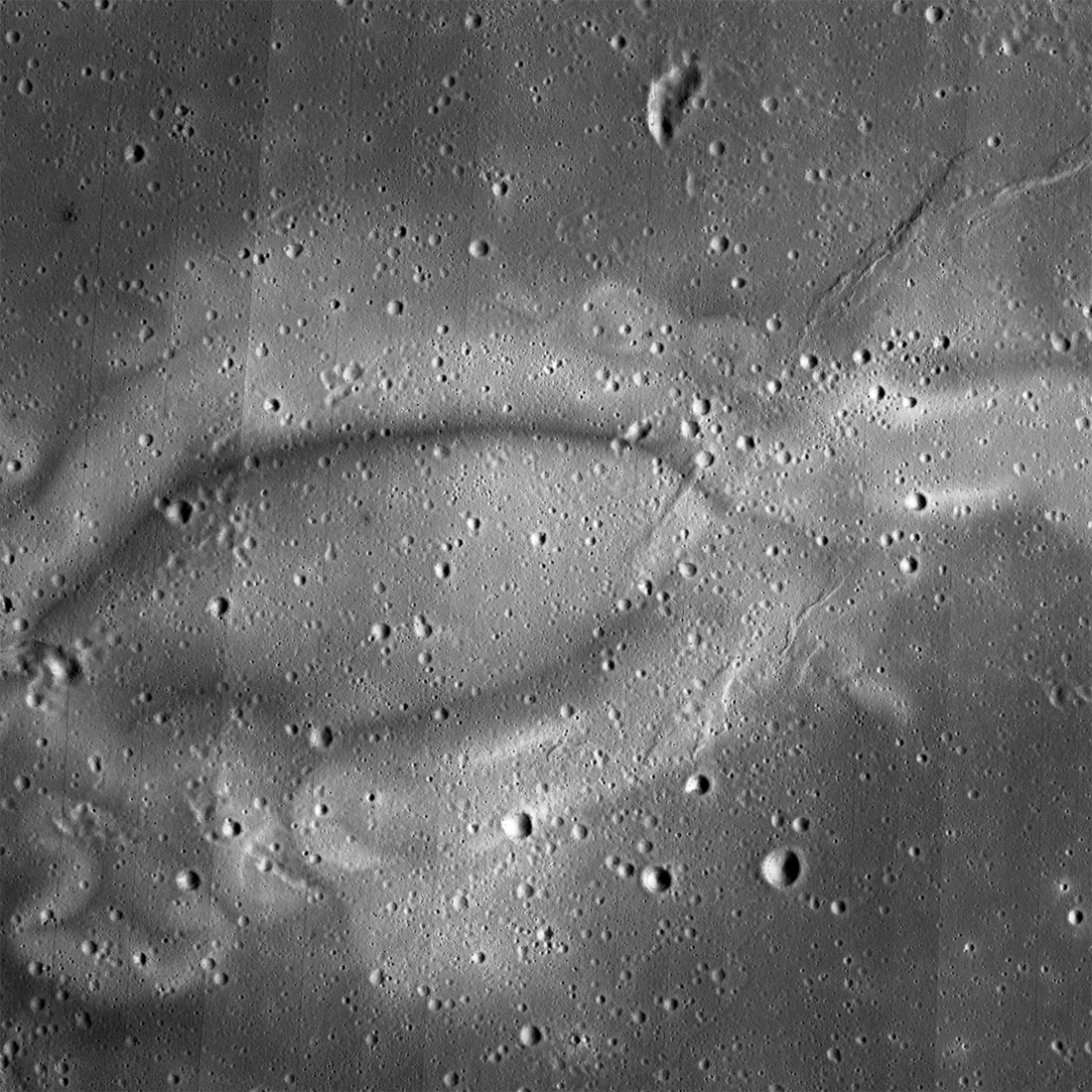
Reiner Gamma Under Earthshine
Lunar swirls are bright, sinuous features that are insensitive to craters and hills, almost as if they were painted across the lunar landscape. Reiner Gamma, found in Oceanus Procellarum, is perhaps the best-known. It is co-located with a magnetic anomaly, and one leading idea is that the local magnetic field steers the solar wind away, slowing soil maturation. Maturation lowers soil reflectance by reducing iron oxide to iron metal and producing glass from the original crystalline grains. Images of Reiner Gamma are typically taken under direct sunlight. Here, the scene is illuminated with earthshine, sunlight bounced off our planet into the lunar night.
Near new Moon on 10 October 2026, KPLO flew over Reiner Gamma on six consecutive orbits. The Sun was 22° to 27° below the horizon, and a nearly full Earth was about 26° above Reiner Gamma to the east. The spacecraft had to roll to keep looking at the same ground, and the strips were acquired with the pixel scale ranging from 2.4 to 4 meters per pixel. We stitched the six images into one mosaic sampled at 15 meters per pixel. The oversampling (~5x) helped increase the signal-to-noise ratio, making for a sharper image.
ShadowCam was designed to image permanently shadowed regions, and is thus about 200 times more sensitive than the LROC NAC. That same high sensitivity results in saturation when imaging sunlit terrain, so a nighttime full Earth over a new Moon is the best time to observe nearside equatorial targets with ShadowCam.
Earthshine is relatively faint, and Reiner Gamma lies about 59° from the sub-Earth point, where earthshine is strongest. This mosaic averages about 0.0007 watts per square meter per steradian per micrometer (0.049 luminance (candela per square meter), -1.4 Exposure Value (EV)), ten to fifteen thousand times dimmer than direct sunlight. A similar Earth scene under a full Moon would be about four times dimmer (EV -3 to -3.5).
Does such a dimly illuminated image still show fine details of the surface? Look closely at the panels below.
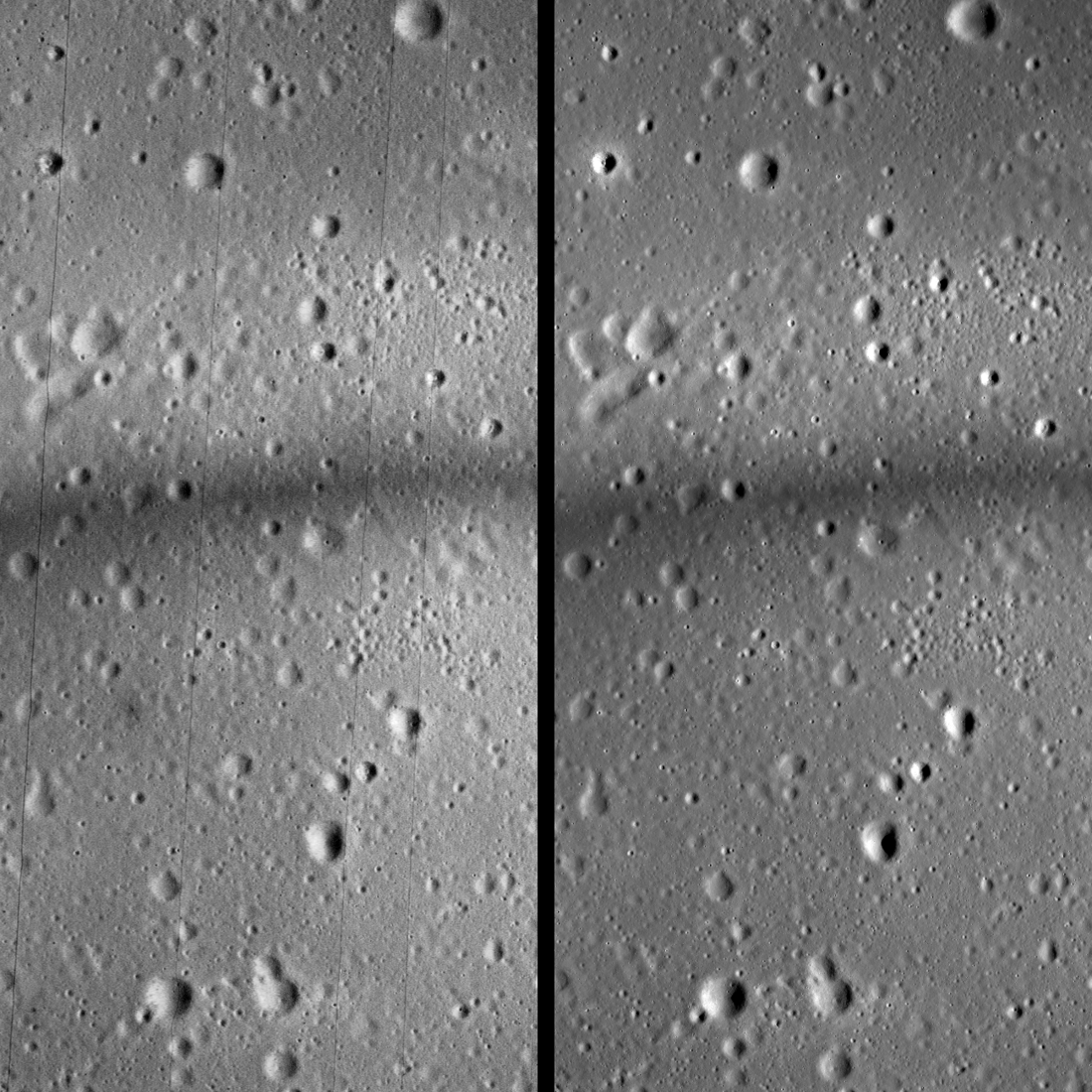
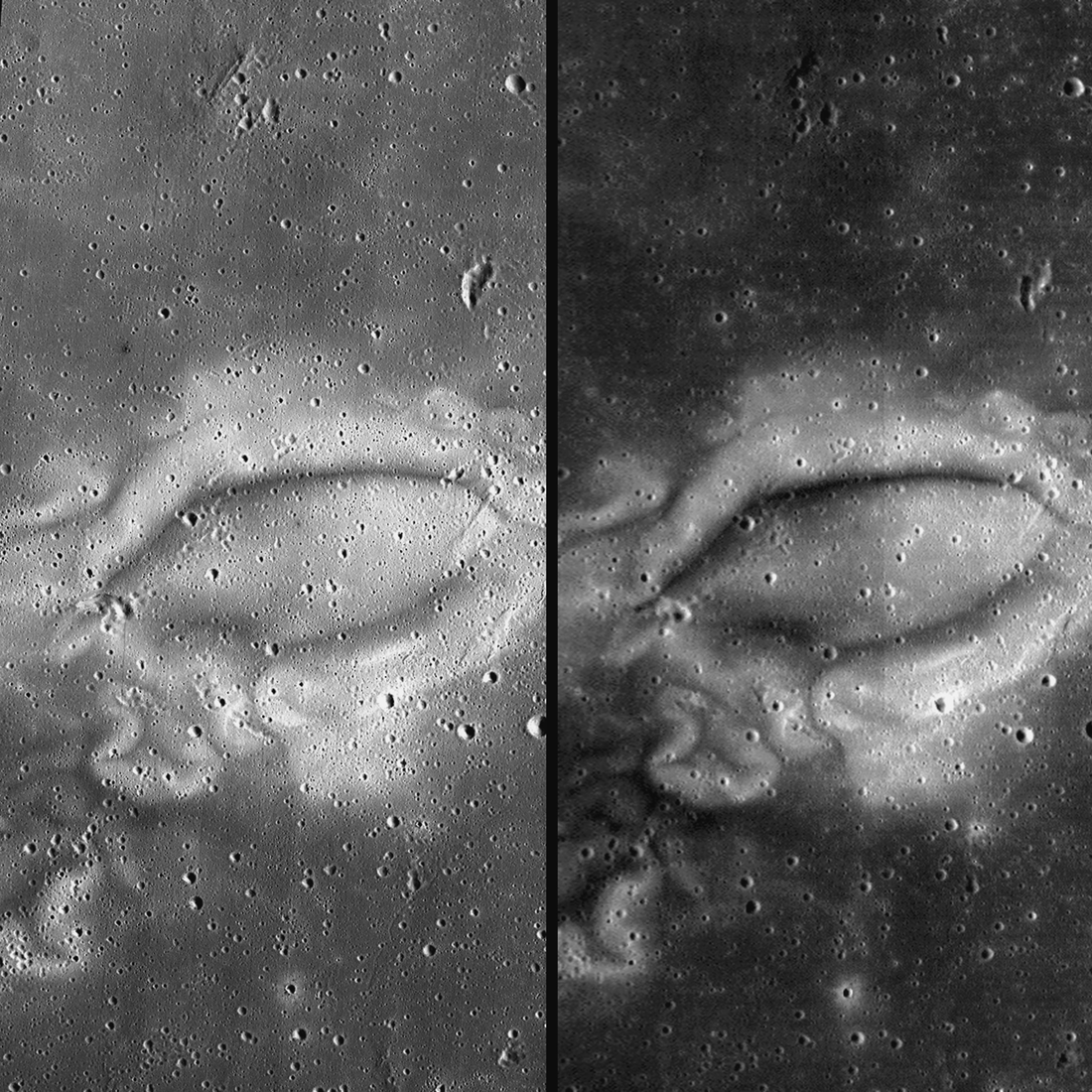
The centuries old mystery of how swirls form may be solved in the first quarter of 2027 when Lunar Vertex carries a magnetometer and other instruments to Reiner Gamma.
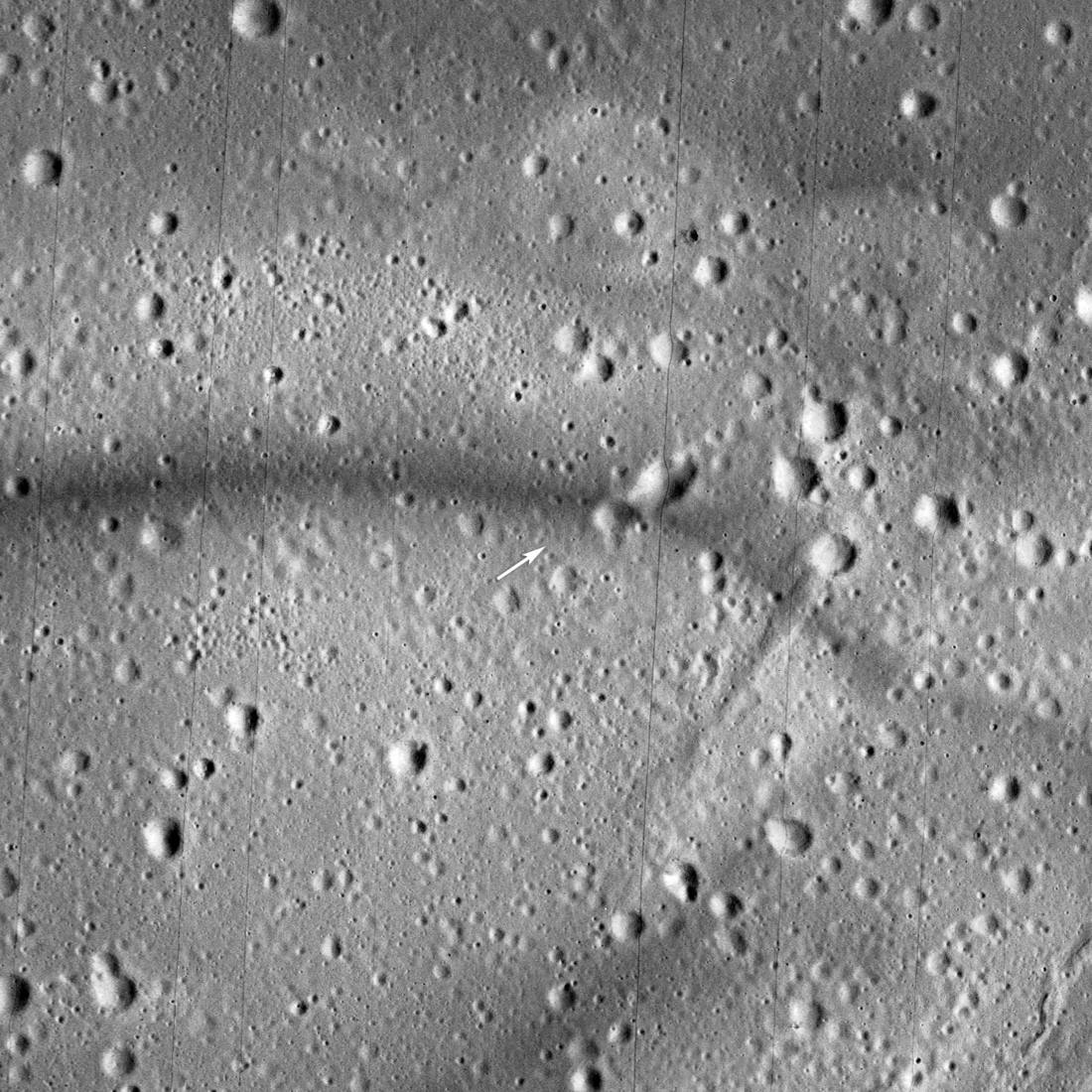
Zoom into the winding lanes of this enigmatic swirl!
Mosaic sampled at 15 meters per pixel, north is up, ShadowCam images M131962156S, M131969397S, M131976647S, M131983889S, M131991133S, M131998393S [NASA/KARI/Intuitive Machines].
Related Feature Images
Reiner Gamma: Swirling in Mystery
Under Earthshine
Aristarchus Crater Under Earthshine
Looking East Over Reiner Gamma
Wrinkled Reiner Gamma
Swirls Across the Moon
Posted by Mark Robinson on 27 October 2026